Abstract
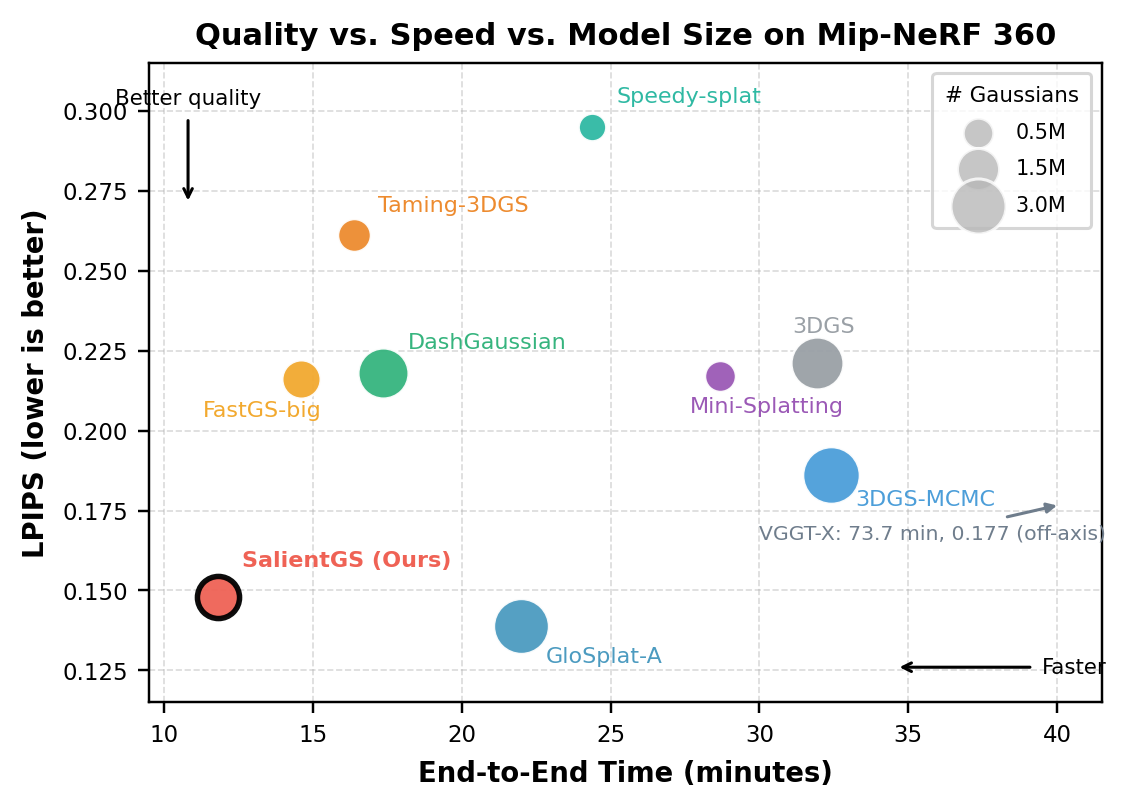
Reconstructing 3D scenes from unordered images remains bottlenecked by expensive Structure-from-Motion preprocessing and frozen pose interfaces. SalientGS is a unified SfM-to-3DGS pipeline whose central contribution is importance-guided MCMC Gaussian allocation. In the released 13-scene verification, SalientGS achieves the best three-benchmark macro-average PSNR, SSIM, LPIPS, and end-to-end runtime among the compared methods, while using a fixed 1.5M-Gaussian budget.
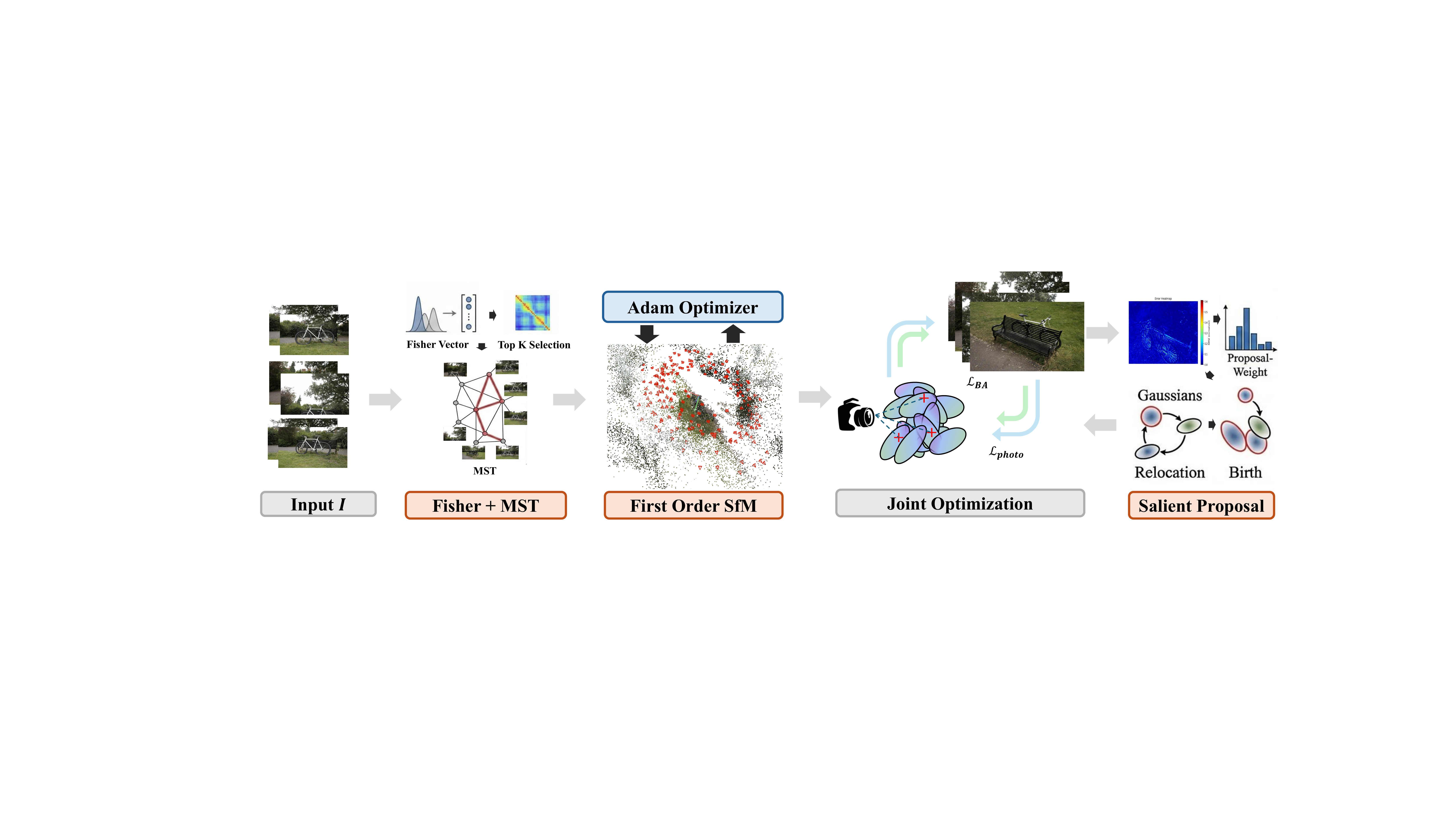
Pipeline
What is new
Importance-guided allocation
Persistent multi-view underfit guides birth and relocation, reallocating capacity from redundant regions.
Unified optimization
Fast first-order SfM is jointly refined with the Gaussian scene using photometric and reprojection losses.
Unordered-image front end
Fisher Vector retrieval and MST connectivity provide a sparse, reliable matching graph without exhaustive matching.
Fixed-budget efficiency
Importance guidance improves quality most when Gaussian capacity is limited, including a 1.0M-versus-1.5M comparison.
Results
| Method | Mip-NeRF 360 PSNR | Mip-NeRF 360 LPIPS | Deep Blending LPIPS | Tanks & Temples LPIPS |
|---|---|---|---|---|
| 3DGS-MCMC | 28.01 | 0.186 | 0.237 | 0.149 |
| GloSplat-A | 28.86 | 0.139 | 0.508* | 0.147 |
| VGGT-X | 26.49 | 0.177 | 0.545† | 0.138 |
| SalientGS | 28.82 | 0.148 | 0.183 | 0.109 |
* GloSplat-A and † VGGT-X fail on the Deep Blending drjohnson scene.
Cross-benchmark macro-average: SalientGS obtains 27.65 dB PSNR, 0.876 SSIM, 0.147 LPIPS, and 10.62 minutes end-to-end. Each benchmark receives equal weight and failed scenes remain included.
Citation
@inproceedings{xiong2026salientgs,
  author    = {Tianyu Xiong and Rui Li and Suning Ge and Jiaqi Yang},
  title     = {SalientGS: Unified SfM-to-3DGS with Importance-Guided MCMC Gaussian Allocation},
  booktitle = {Proceedings of the 34th ACM International Conference on Multimedia},
  year      = {2026}
}